
The Great Mushroom Debate Is Missing the Point
By: Adam Berkelmans
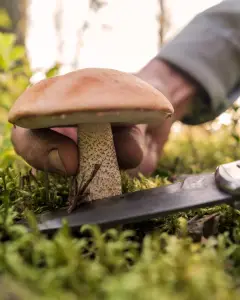
I’m just going to go ahead and say it.
You’re a monster if you pull a mushroom out of the ground without cutting it.
Er… wait. That wasn’t it.
You’re a monster if you cut mushrooms instead of pulling them!
Yeah, that’ll show you, you commie mushroom-cutting scoundrels.
Wait. No.
Oh dear, I’ve gotten myself all turned around and confused.
__________________
To Cut, or to Pull a Mushroom, That is the Question…
Take part in any online wild mushroom harvesting conversation on social media and you’ll probably eventually see it divide itself into two camps: the pullers and the cutters.
Each side shouts as loud as it can, offering links to dubious studies or opinion pieces “proving” that they’re on the right side.
Cutters insist that by pulling the mushroom from the ground, you’re disturbing the mycelium (the root-like network of fungal threads supporting mushrooms) and harming the entire organism. Generations of mushroom harvesters in the old world were cutting, why argue with ancestral wisdom? Regardless, cutting mushrooms at the base makes for a much cleaner harvest, with less dirt ending up in your basket.
Pullers insist that mushrooms are merely fruiting bodies, akin to an apple on a tree. Pulling one or two apples off surely won’t hurt anything, will it? Besides, squirrels and other forest creatures regularly dig up mushrooms, which isn’t any different, and most fungi has evolved to deal with these disturbances. Additionally, the portion of mushroom growing underground is necessary to see when correctly identifying some species—very important if you’re planning on eating them.
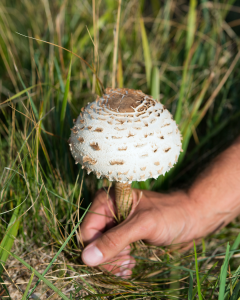
So which side is correct?
Well… both, really.
And neither.
It’s more nuanced than it seems and, as we’ll see, is obfuscating a more important detail.
Hank Shaw said it best in a recent essay on his excellent Substack, To the Bone.
“… Americans suck at nuance. We increasingly treat ethics as branding. We all want simple villains and simple saints, but fair judgment rewards proximity and demands attention, humility, and yes, sometimes discomfort. It requires us to tolerate uncertainty and competing truths at the same time. Most humans hate that feeling.”
It’s become a very emotionally charged topic with neither side willing to back down, and not too many foragers willing to take a more nuanced approach. In these cases, I find it helps to look at accepted science concerning the matter rather than choosing a side and digging my heels in.
The current scientific consensus on the matter is probably the best way to answer whether or not cutting or pulling is the end-all-be-all of mushroom harvesting, and, as is often the case, the scientific evidence is much less dramatic than the folklore.
The most widely-accepted study* came out of Switzerland, where researchers monitored heavily harvested populations of wild edible mushrooms over three decades, comparing plots of mushrooms left untouched, plots harvested by careful pulling, and plots harvested by cutting at the base.
Their main conclusion was that long-term mushroom harvesting didn’t reduce mushroom production nor species richness, whether or not the mushrooms were cut or pulled.
“But, but, but,” the cutters sputter.
“That can’t be right!” the pullers declare.
But this wasn’t your granddaddy affectionately patting you on the head and sharing his wisdom about always cutting mushrooms. This was an exhaustive and methodological study that counted about 150,000 fruiting bodies (mushrooms) across more than 500 species, for 29 years. It doesn’t get much better than that when it comes to proving a point.
Now, I know science isn’t infallible. Maybe we’ll learn some day that your mushroom-cutting granddaddy was right all along and there was some minuscule web of cause and effect showing that pulling mushrooms and disturbing the mycelial networks causes a shiver through the wood-wide-web, reducing the lifespans of surrounding trees.
Not likely though. And when you strip away tradition, and stubbornness, and emotion, the current data is the best we’ve got to inform our decisions moving forward.
So, what does this study teach us? That you can be a cutter or a puller and it doesn’t really matter. You do you! While you’re at it, mind your own business and let others do as they see fit, as long it’s not harming anything. People often become emotionally invested in binary positions, while the evidence sometimes suggests they’re arguing about the wrong thing — or nothing at all.
There was something else that became apparent through this study that doesn’t get talked about enough, lost under the pileup of cutting vs. pulling squabbles, and oft-ignored since it didn’t help to prove one side or another in online arguments.
The thing that DOES very much affect the number of fruiting bodies observed is habitat disturbance and soil compaction due to trampling. That trampling is being done by both cutters and pullers, whatever their method is.
Interestingly, the study observed that trampling didn’t seem to actually affect the mycelium under the ground, but did lead to less mushrooms sprouting year after year. So, what’s happening then?
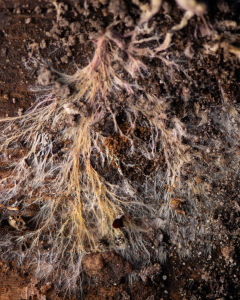
Researchers suggest that while the mycelial threads remain relatively unharmed, young mushrooms near the surface of the soil get physically crushed by footfalls, reducing the total production within a fruiting season.
Walking around your mushroom patch seems to be having much more of an effect on overall mushroom production than actual harvesting methods. That’s good to know, and this information has caused this mushroom forager at least, to attempt to step much more lightly when off the trail.
Of course, logging equipment, development, and habitat loss will always have a far greater impact than a lone forager wandering through the woods. But the principle remains the same: tread lightly, harvest thoughtfully, and don’t lose sight of what actually matters.
The real stewardship lesson here isn’t “cut versus pull.”
It’s “watch where you step.”
*Simon Egli et al. (2006). Mushroom picking does not impair future harvests – Results of a long-term study in Switzerland. Biological Conservation 129(2):271–276.